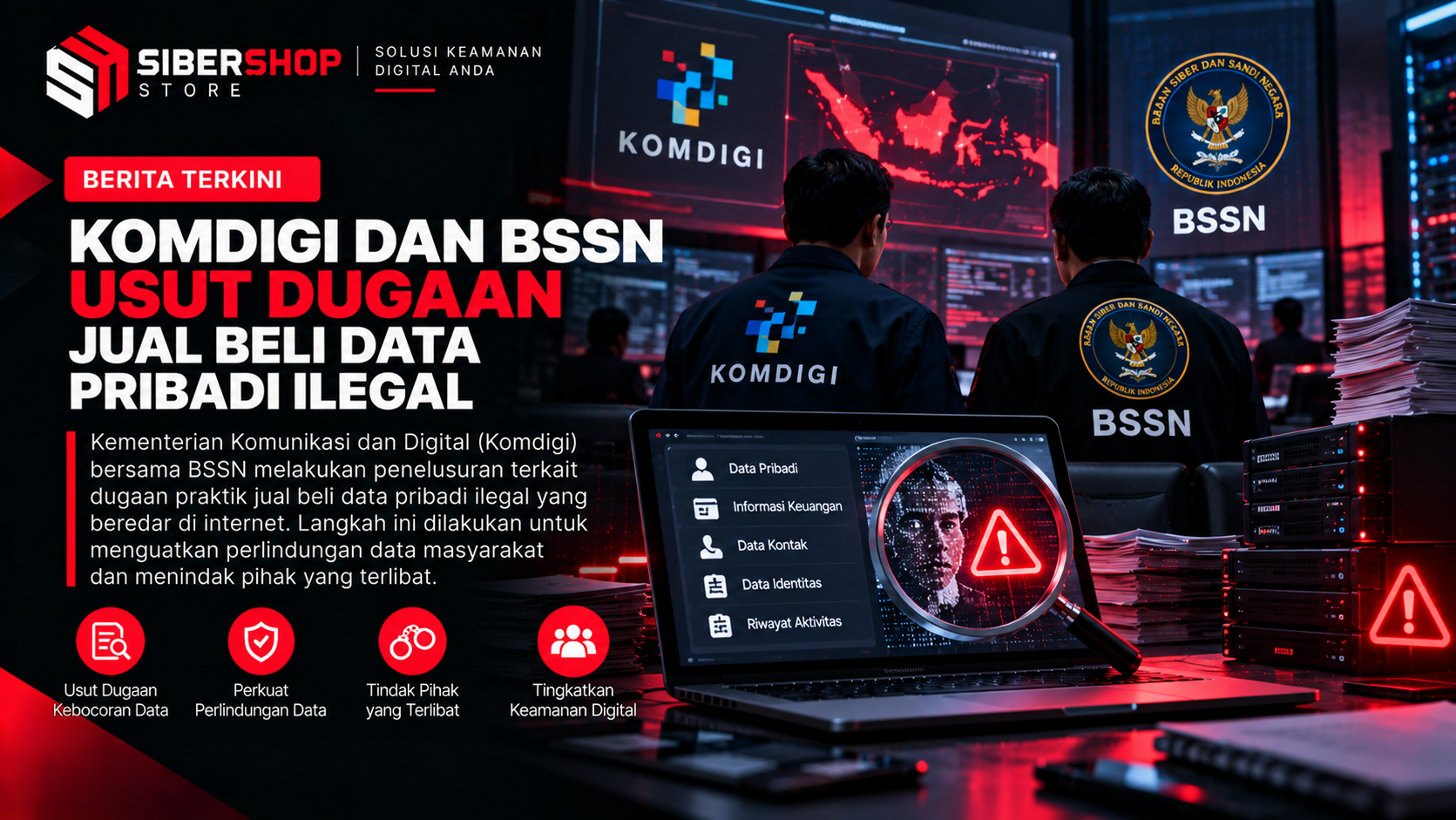
BSSN Reveals an Unprecedented Surge in Traffic Anomalies
Indonesia's National Cyber and Crypto Agency (BSSN) has released data that shows just how much pressure the country's cyberspace is under. The findings were presented on Thursday, April 23, 2026, at the R17 Podcast Show Vol.4 in Jakarta. The speaker was Major General (TNI) Bondan Widiawan, Deputy for Cyber Security and Cryptography Operations at BSSN. According to detikInet, BSSN recorded 5.5 billion traffic anomalies throughout 2025. That figure exceeds the cumulative total recorded from 2020 to 2024.
The upward trend shows no sign of slowing this year. For the period from January 1 to April 15, 2026 alone, BSSN has already logged 1.5 billion traffic anomalies. In other words, in less than four months the count has approached one third of the full-year total for 2025. For businesses and government agencies, this data signals that cyber threats are no longer a seasonal concern. Attacks happen every day and target systems with widely varying levels of security readiness.
Malware Dominates as Legacy Approaches Fall Behind
In his presentation, Bondan explained that the detected anomalies are dominated by malware. This is consistent with global attack patterns, which increasingly rely on malicious software to steal data, take over systems, or recruit victims' devices into attack networks. Malware often gets in through gaps that seem trivial, such as email attachments, pirated applications, or unpatched software. Once inside, its activity is often invisible to the user. As a result, many organizations only discover an infection after the damage has spread.
BSSN also considers traditional methods no longer effective against the current scale of threats. Detection that relies only on known attack signatures, for example, is easily evaded by new malware variants that keep changing. Traffic volumes reaching billions of anomalies are also impossible for any security team to analyze manually. For this reason, BSSN stresses the need for more advanced approaches, including the use of artificial intelligence (AI). The technology can help sort suspicious patterns faster and reduce the workload on analysts.
Paraphrase of BSSN's statement, not a direct quote. The steadily rising traffic anomalies are dominated by malware, so handling them requires advanced approaches including the use of AI, as traditional methods are considered no longer effective.
Notifications Sent, but Responses Remain Incomplete
Beyond monitoring traffic, BSSN routinely sends notifications to parties whose systems show signs of anomalies. Throughout 2025, BSSN sent 2,855 notifications, of which 2,186 received a response. In 2026 through April, 1,002 notifications were sent and 776 received a response. That works out to roughly three in four notifications receiving a reply in both periods. For the remainder, numbering in the hundreds, it is unclear whether they were acted on or simply ignored.
The problem is that BSSN has no authority to compel follow-up when a notification goes unanswered. This leaves the effectiveness of early warnings heavily dependent on each recipient's awareness. An infected system that is left alone can become an entry point for further attacks, both on the organization itself and on connected partners. BSSN is therefore pushing for new cybersecurity regulation. Such regulation is expected to provide a stronger legal basis so that warnings do not end up as mere notices.
What It Means for Companies
This BSSN data should be read as a warning for senior management, not only for IT teams. The surge in traffic anomalies shows that the likelihood of an organization being targeted is growing year after year. Companies that receive a notification from BSSN need a clear procedure for who responds and how quickly. Without one, notifications can easily get lost in an inbox or change hands without being resolved. Slow handling can magnify losses, from service disruptions to customer data breaches.
There are several basic steps organizations can consider to reduce their risk. Most of them do not require a large upfront investment. What matters more is consistency in carrying them out. The following deserve to be priorities.
- Appoint an official owner to receive and act on security notifications from BSSN and other parties.
- Regularly update operating systems, applications, and network devices to close gaps that malware frequently exploits.
- Monitor traffic and logs on a regular basis so unusual activity is detected quickly.
- Train employees to recognize phishing emails and suspicious attachments.
- Prepare an incident response plan that is actually tested, not just kept on file.
Impact on Individuals and Digital Reputation
Malware threats are not limited to large corporations. An infected personal device can become a source of leaked accounts, photos, and important documents. Leaked data can then circulate on dark web forums or be misused for fraud in the victim's name. In many cases the knock-on effects reach a person's reputation, for example when a social media account is hijacked and used to spread damaging content. Recovering from situations like this often takes far longer than preventing them.
Individuals are advised to enable two-factor authentication, use a different password for every service, and avoid apps from unofficial sources. These simple habits can close off most of the entry points attackers rely on. Device updates should not be postponed either, since many of them contain security fixes. If there are signs that an account has been accessed by someone else, it needs to be secured immediately. How quickly you act often determines how far the damage spreads.
Regulation as a Shared Responsibility
BSSN's push for new cybersecurity regulation points to a gap between detection capability and enforcement authority. Indonesia already has a personal data protection framework through the PDP Law, but cybersecurity more broadly still needs a firm legal foundation. Good regulation should set out obligations to respond to notifications, minimum security standards, and coordination mechanisms for major incidents. Without it, BSSN's efforts risk stopping at the monitoring stage. At the same time, the regulation needs to be drafted with the capabilities of small and medium-sized businesses in mind.
While that regulation takes shape, organizations do not need to wait for a legal obligation to get their house in order. The figures of 5.5 billion anomalies in 2025 and 1.5 billion by mid-April 2026 are reason enough. Cybersecurity now bears directly on business continuity, customer trust, and an organization's good name. Taking notifications seriously is the very first step anyone can take. The next is building security habits that are practiced every day, not only when an incident occurs.